CHICAGO – President-elect Barack Obama said Saturday he's asked his economic team for a recovery plan that saves or creates more than 2 million jobs, makes public buildings more energy-efficient and invests in the country's roads and schools.

"We won't just throw money at the problem," Obama said in his weekly radio address and Internet video. "We'll measure progress by the reforms we make and the results we achieve — by the jobs we create, by the energy we save, by whether America is more competitive in the world."

Obama's remarks come after the Labor Department announced Friday that employers cut 533,000 jobs in November, the most in 34 years.

Obama said his plan would put millions of people to work by "making the single largest new investment in our national infrastructure since the creation of the federal highway system in the 1950s."

He also wants to install energy-saving light bulbs and replace old heating systems in federal buildings to cut costs and create jobs.

School buildings would get an upgrade, too. "Because to help our children compete in a 21st century economy, we need to send them to 21st century schools," Obama said.

As a part of the plan, Obama said he wants to expand Internet access in communities. Hospitals also should be connected to each other online.

"Here, in the country that invented the Internet, every child should have the chance to get online," he said.

Obama said he would announce other details of the economic recovery plan in the coming weeks. He said he'd work with Congress to pass the initiative when lawmakers reconvene in January.

[Read More...]

In his Youtubed weekly radio address -- you can hear it HERE -- President-elect Obama provides more details about his economic recovery plan.

"We need action –- and action now," Mr. Obama says. "That is why I have asked my economic team to develop an economic recovery plan for both Wall Street and Main Street that will help save or create at least two-and-a-half million jobs, while rebuilding our infrastructure, improving our schools, reducing our dependence on oil and saving billions of dollars."


You might notice that the Obama Transition Team has done a better job of gussying up the office where PEBO delivers this weekly address to make it appear far more Oval Officey.

The president-elect doesn't put a price tag on his stimulus proposals, but he outlines five aspects to his massive spending proposal:

Making public buildings more energy-efficient; making it big -- "the single largest new investment in our national infrastructure since President Eisenhower established the Interstate Highway System in the 1950s"; modernizing and upgrading school buildings; Boosting broadband deployment throughout the U.S.; and modernizing the health care system -- cutting-edge technology and electronic medical records.

"We need to act with the urgency this moment demands to save or create at least two-and-a-half million jobs so that the nearly two million Americans who’ve lost them know that they have a future. And that’s exactly what I intend to do as president of the United States," Mr. Obama says.

Jake Tapper is ABC News' Senior White House Correspondent based in the network's Washington bureau. He writes about politics and popular culture and covers a range of national stories.

[Read More...]

Campaign Says 4 Million Contributed, But Nonpartisan Group Finds Majority Of Funds Came From Larger Donors

(AP)
Barack Obama, who rewrote the book on presidential fundraising, amassed more than $745 million during his marathon campaign, more than twice the amount obtained by his rival, Republican John McCain.

In his latest finance report, Mr. Obama reported raising $104 million in more than five weeks immediately before and after Election Day. It was his second biggest fundraising period and a fitting coda to a successful presidential bid that shattered fundraising records.

In the end, Mr. Obama still had $30 million left over.

Overall, Mr. Obama exceeded the combined finances of the two major parties' nominees four years ago. George W. Bush and John Kerry pulled in a total of $653 million in the 2004 primary and general election campaigns, including federal public financing money.

Mr. Obama's prowess at attracting money, one of the many characteristics that defined his campaign, could well spell the end of a 30-year experiment in public financing of presidential contests.

After initially vowing to take public funds if McCain did, Mr. Obama became the first presidential candidate since the campaign finance reforms of the 1970s to raise private donations during the general election.

The final numbers underscore how pivotal the two candidates' strategies were for funding their general election campaigns: McCain accepted $84 million in taxpayer money through the public financing system; Mr. Obama gambled that he could raise far more from private money.

The two campaigns spent identical amounts in June, $25.6 million each. But from there the numbers diverged widely in September and October when the Obama financial juggernaut swamped McCain. By the end, the Democrat was outspending his rival four to one. The reports submitted by the campaigns on Thursday covered the period from Oct. 15 to Nov. 24.

McCain relied heavily on the Republican National Committee to help narrow the financial discrepancy. But even with the party resources Mr. Obama had a vast money advantage.

The party committee couldn't escape one of its most awkward moments of the campaign. After spending nearly $150,000 on clothing and accessories for McCain's running mate Sarah Palin in September, the party reported spending more than $23,000 in additional accessories in the latest finance document. The spending ranged from $4,384 at Saks Fifth Ave. to $2,130 at Nieman Marcus to small purchases at Wal-Mart and CVS.

Party spokesman Alex Conant said Thursday that the expenditures listed in the party's October and December reports "were the result of coordinated expenditures at the campaign's direction."

"Accessories have been returned, inventoried, and will be appropriately dispersed to various charities," Conant said.

The RNC reported raising $75 million during the latest reporting period. Overall this year, the party committee raised $322 million. It ended with $13.5 million cash on hand. The Democratic National Committee reported raising $36.5 million in its latest filing, for a total of $186 million for the year. The party had $8.7 million cash on hand, but it also reported owing $5 million on a line of credit.

Mr. Obama's campaign said nearly 4 million donors contributed to his campaign.

But while Mr. Obama has made much of his large number of donors, the nonpartisan Campaign Finance Institute found that Obama collected about 26 percent of his total haul from people who gave less than $200 - about the same as President George W. Bush did in his 2004 campaign.

And like other campaigns, Mr. Obama's relied for nearly half of its fundraising on big donors, those who gave $1,000 or more, a finding that "should make one think twice before describing small donors as the financial engine of the Obama campaign," the institute reported.

Mr. Obama reported having nearly $30 million in the bank at the end of the reporting period and nearly $600,000 in debts. McCain reported $4 million in the bank, nearly $5 million in debts and $1 million owed to the campaign committee. McCain also filed a report for a compliance fund, used to cover expenses associated with his acceptance of public funds. He reported $25 million left over in that account.

[Read More...]

By Martha Raddatz, Richard Coolidge, Kirit Radia, Luis Martinez, Jake On Jan. 20, President-elect Barack Obama inherits a nation that is in financial turmoil and waging wars on two fronts overseas, which makes a quick, smooth transition imperative.

Already, Obama is hard at work selecting his Cabinet and administration.

The balloons had barely settled in Chicago's Grant Park on election night before Obama got down to business in picking his team. Some believe President Clinton handicapped himself in his first year by not moving quickly enough during the transition period. Clinton did not select his chief of staff, Leon Panetta, until days before his inauguration.

President-elect Barack Obama has moved quickly to nominate his Cabinet and fill top administration positions.
(Alex Brandon/AP Photo)

Here are Obama's picks and top contenders so far.

Obama picked New Mexico Gov. Bill Richardson for secretary of commerce, making him the first Latino in the Cabinet. Richardson is a former Clinton Cabinet member, having served as secretary of energy under Clinton. He is also a former United Nations ambassador. Richardson abandoned his own bid for Democratic nomination for president last January, and endorsed Obama in March, despite his close relationship to the Clintons.

New York Sen. Hillary Clinton was officially announced as Obama's secretary of state on Dec. 1, just months after she lost her own historic bid to become the first female president. During the primaries, Clinton and Obama fought each other over foreign policy, especially the Iraq War. Clinton voted to authorize President Bush's use of force against Saddam Hussein in 2003, but during her campaign, she denounced the war. Perhaps the most infamous episode during the campaign occurred when Clinton claimed in a speech that on a trip to Bosnia in 1996, she had landed under "sniper fire." Only a video from her trip later showed that Clinton and her daughter, Chelsea, had walked calmly off the plane in Tuzla, forcing her to take back her words. Clinton has served as New York's junior senator since 2001, and sits on the Armed Services, Budget, Health, and Environment and Public Works committees. In 1996, Clinton published her best-selling book, "It Takes a Village and Other Lessons Children Teach Us." She won a Grammy award for the recorded version.

Defense Secretary Robert Gates -- a registered independent -- will be staying on in the top Pentagon job for at least the first year of the Obama administration. Barack Obama has indicated he wants a bipar

tisan Cabinet, and keeping Gates in his position might avert criticism of partisanship. Gates was appointed by president Bush in 2006 following Don

ald Rumsfeld's departure. Before taking the top job at Defense, Gates served as president of Texas A&M University but had spent a lifetime in intelligence and military, having worked as an adviser to President Reagan and as CIA director from 1991 to1993 under President George H.W. Bush.

Susan Rice, picked as the new U.S. ambassador to the United Nations, will have her work cut out for her. Under the Bush administration, relations between the U.S. and the U.N. became strained, with many unhappy with the unilateral goals of the U.S. government and the means with which it pursued them -- including the invasion of Iraq. With a new administration, there is a hope at U.N. headquarters that "business as usual" with the United States will change. Rice's experience in government includes serving on the National Security Council during the first Clinton administration, where for two years she was special assistant to the president and senior director for African affairs. In 1997, she became assistant secretary of state for African Affairs. During her tenure, the twin embassy bombings in Kenya and Tanzania took place, giving her exposure to al Qaeda. In 2002, she joined the Brookings Institution and during the 2004 presidential campaign, she was an adviser to Sen. John Kerry. During the 2008 presidential campaign, she was a top foreign policy adviser to Barack Obama, and it appears that her counsel, wisdom and advice, along with her experience, have earned her the trust of the incoming president.

Washington lawyer Eric Holder has been appointed as the attorney general in the Obama administration. Holder, 57, is the first black to hold several top Justice Department positions and if confirmed by the U.S. Senate, will be the first black attorney general.

Holder served as the first black deputy attorney general, working under then-Attorney General Janet Reno during the Clinton administration. While at the Justice Department, Holder was viewed as a centrist on most law enforcement issues, though he has sharply criticized the secrecy and the expansive views of executive power advanced by the Bush Justice Department.

Second-term Arizona Gov. Janet Napolitano was picked to lead the Department of Homeland Security. Napolitano, who served as adviser on Obama's transition team, is the first female Homeland Security secretary. An early supporter of the president-elect, Napolitano is a popular Democrat in Republican-leaning Arizona, which went in the election for native son Sen. John McCain.

Napolitano was Arizona's first female attorney general before her appointment as governor. She has been outspoken on immigration issues and has been an advocate of more federal government responsibility in border control issues.

Marine General James L. Jones will serve as Obama's National Security Advisor. The 64-year-old served for 40 years in the Marine Corps, rising from a platoon commander in Vietnam to Commandant of the Marine Corps and later served as Supreme Allied Commander of NATO. Since retiring last year as a four-star general, he has served as the Bush administration's special envoy for Middle East security and chaired the Independent Commission on the Security Forces of Iraq, a blue ribbon panel appointed by Congress that assessed the readiness of Iraqi troops. As National Security Adviser, Jones will serve as President Obama's chief adviser on national security affairs and help coordinate the interagency efforts of the Pentagon, the State Department and the intelligence community. Some of the national security issues Jones will be facing include the management of the wars in Iraq and Afghanistan and combating the terrorist threat in Pakistan; and containing the nuclear aspirations of an ambitious Iran and a flip-flopping North Korea.

Retired Admiral Dennis Blair is the top contender for the position of Director of National Intelligence, and if he takes over from Mike McConnell, he will be only the third person to have served as the nation's most important intelligence officer. The post was created in 2004 as part of the intelligence community reforms following the September 11th attacks. The director is responsible for streamlining the gathering and analysis from the 16 different agencies that make up the intelligence community. Blair last held a government job in 2002, when he retired -- after 30 years in the US Navy -- as Commander of U.S. Pacific Command. From 2003-2006, he was president of the Institute for Defense Analyses, which was largely funded by the federal government to look at military issues. The former Rhodes Scholar is considered a deep thinker with vast experience in the intelligence arena. He worked as Director of the Joint Staff in the Office of the Chairman of the Joint Chiefs at the Pentagon. He also worked in the White House on the National Security Council and was the first Associate Director of Central Intelligence for Military Support. Best story: He is known for trying to water ski behind a destroyer -- the USS Cochrane, which he commanded in the mid 1980's.

Paul Volcker

Barack Obama tapped 81-year-old Paul Volcker to chair the President-elect's Economic Recovery Advisory Board, which will be responsible for offering independent, non-partisan economic analysis and advice to Obama. Volcker served as Federal Reserve Chairman under presidents Carter and Reagan. He has been criticized for driving up interest rates during his time but is also known for cutting inflation. One of Obama's top economic advisors during the campaign, Volcker has been a staunch proponent of government regulation. Austan Goolsbee, an economics professor at the University of Chicago, will serve as Staff Director and Chief Economist of the Recovery Advisory Board and act as the primary liaison between the Board and the Administration.

Timothy Geithner

Obama announced his economic team Nov. 24, including his selection of Timothy J. Geithner to be secretary of treasury. Geithner is president of the New York Federal Reserve. Similarities between Geithner and the President-elect are clear at every turn. Geithner is well-known on Wall Street and the Dow Jones Industrial Average soared almost 500 points Nov. 21 when the news leaked out.

Larry Summers

Larry Summers has been tapped to lead Obama's National Economic Council. Summers was Treasury secretary under Clinton and became president of Harvard University after leaving Treasury in 2001. He resigned from his post at Harvard a year after making a controversial speech about women's success in math and science careers.

Before serving in the Clinton administration, Summers was one of the youngest tenured professors in Harvard's history, served as chief economist of the World Bank, and worked as an economic adviser in the Reagan administration. Summers' appointment to the National Economic Council does not require Senate confirmation.

Christina Romer

To lead the Council of Economic Advisers, which is in the executive office of the president, Obama selected Christina Romer. Romer is a well-respected economist and economics professor at the University of California at Berkeley. Previous chairs of the Council of Economic Advisers include Ben Bernanke, Greg Mankiw, Laura D'Andrea Tyson, and Alan Greenspan.

Melody Barnes

Obama also announced that Melody Barnes would be director of the Domestic Policy Council. Barnes is the executive vice president for policy at the Center for American Progress. She has also served as Sen. Edward Kennedy's chief counsel on the Senate Judiciary Committee and as the U.S. Equal Employment Opportunity Commission's director of legislative affairs.

Tom Daschle

ABC News has confirmed that Tom Daschle has accepted an offer from Obama to lead the nation's Department of Health and Human Services. If confirmed by the Senate, the former South Dakota senator would replace Health and Human Services Secretary Michael Leavitt in guiding critical, high-profile federal agencies, including the Food and Drug Administration, the Centers for Disease Control and Prevention, the Centers for Medicare and Medicaid Services, and the National Institutes of Health.

Daschle was Senate majority leader under Clinton. Even before Obama was elected, he had reportedly told confidantes he was most interested in a position at HHS because he thought health care would be one of the most important issues facing the new administration. His book, "Critical: What We Can Do About the Health Care Crisis," was published in February.

Rep. Rahm Emanuel, D-Ill., has accepted the position of White House chief of staff. A veteran of the Clinton administration and a close Obama political ally from Chicago, Emanuel brings experience, knowledge of Capitol Hill and a sense of duty and loyalty. Obama reportedly told associates, according to ABC News' George Stephanopoulos, that he believes Emanuel will "have his back."

Emanuel served 6½ years under Clinton and has been a member of Congress for four terms. He has moved up through the congressional ranks and knows how to work Washington. While these are certainly qualifications for his new job, they also may have posed some reservations in him accepting the position. Emanuel was said to have ambitions to someday be House speaker. He also has young children and cited his family as a big consideration when making the decision.

Obama chief campaign strategist David Axelrod has been tapped to be White House senior advisor. The Chicago native has known the president-elect since 1993, longer than anyone else in Obama's inner circle. He is widely credited for helping Obama's political ascent and has been on the forefront of his campaign.

In his acceptance speech, Obama said Axelrod has been "a partner with me every step of the way." Axelrod is not new to the political scene. He has advised several Democratic candidates since 1985 and is reportedly close friends with Chicago Mayor Richard M. Daley.

In a profile of Axelrod, the Los Angeles Times cited a description of him as "Obama's answer to Karl Rove and the most powerful political consultant not on a coast." Axelrod has said he became interested in politics at the age of 5, when he watched John F. Kennedy become president.

Robert Gibbs

Robert Gibbs, one of Obama's top aides, will become Obama's White House press secretary. Gibbs helped lead the campaign's communication team as the senior strategist for communications and message.

The 37-year-old Alabama native is a regular on cable news and the morning talk show circuit. Despite the occasional sparring with "Fox and Friends" host Sean Hannity, the lighthearted Gibbs is said to have a good rapport with reporters.

The potential White House podium dweller is a longtime Obama loyalist and has been a constant force on the trail ever since the president-elect first ran for the U.S. Senate in 2004. Before working for Obama, Gibbs was an aide to Sen. John Kerry in 2003. He left the Kerry campaign before Kerry clinched the 2004 presidential nomination.

Peter Orszag

Obama nominated Peter Orszag as director of the Office of Management and Budget director. Orszag began his assignment as the seventh director of the Congressional Budget Office in January 2007, and during his term, has been credited for his work on health care and climate issues. Like many other Cabinet picks, Orszag is a veteran of the Clinton White House where he previously served as an economic adviser.

Valerie Jarrett

Close Obama family friend and adviser Valerie Jarrett is serving as a White House adviser. An Obama campaign source tells ABC News that Jarrett has been named senior advisor and assistant to the president for intergovernmental relations and public liaison.

John Podesta

John Podesta heads up Obama's transition team. Podesta served as White House chief of staff under Clinton from October 1998 until the end of his term and is currently the president and CEO of the Center for American Progress.

[Read More...]

By JIM KUHNHENN Associated Press Writer
WASHINGTON

Democrats are growing impatient with President-elect Barack Obama's refusal to inject himself in the major economic crises confronting the country. Obama has sidestepped some policy questions by saying there is only one president at a time. But the dodge is wearing thin. "He's going to have to be more assertive than he's been," House Financial Services Committee Chairman Barney Frank, D-Mass., told consumer advocates Thursday.

Frank, who has been dealing with both the bailout of the financial industry and a proposed rescue of Detroit automakers, said Obama needs to play a more significant role on economic issues.

"At a time of great crisis with mortgage foreclosures and autos, he says we only have one president at a time," Frank said. "I'm afraid that overstates the number of presidents we have. He's got to remedy that situation."

Obama has maintained one of the most public images of any president-elect. He has held half a dozen press conferences, where he has entertained question after question about the economy, the mortgage crisis, and the flailing auto industry. He called for passage of extended unemployment benefits — which has passed — and even a stimulus package if possible before Jan. 20. But he has stayed away from trying to dictate remedies for the toughest problems Congress is confronting: the auto industry's troubles and how to spend the $700 billion bailout.

Frank's remarks came as the Bush administration considers whether it needs the second half of the $700 billion of the Troubled Asset Relief Program aimed at helping the financial sector before Obama takes office on Jan. 20.

An Obama official said the Bush administration reached out to the transition team about tapping into the money. The official, speaking on the condition of anonymity because of the sensitivity of the talks, said Obama's transition team urged the administration to talk to bipartisan congressional leaders and assemble a meeting between the White House and Congress. The official said the Obama team offered to participate in a bipartisan meeting if it would be helpful.

Impatient Democrats say Barack Obama must take hands-on approach to major economic crises

Earlier this week, Obama was asked whether he worried that Treasury Secretary Henry Paulson might begin spending the next installment of the money before he assumes the presidency. Obama demurred.

"Until Secretary Paulson indicates publicly that he's drawing down the second tranche, the second half of the TARP money, it would be speculation on my part to suggest that that money's going to be used up," he told reporters at a Chicago news conference Wednesday.

Obama did stress that a significant component of the fund should be used to reduce the number of foreclosures. But he did not specify a particular remedy.

He also declined to take a stand in a debate over the source of money for an auto loan package. The dispute has divided Democrats and hindered progress on assistance for the industry. At issue is whether to take money from the $700 billion designated for the financial sector or to take it from a previously approved loan aimed at manufacturing more energy efficient cars.

"I think it's premature to get into that issue," Obama said at the conference.

Presidents-elect typically spend the transition period assembling their cabinets, their White House staff and preparing to take the reins of power. But this transition is occurring at an extraordinary time, with bad economic news mounting by the day and with one of the country's major industries begging for a hand to keep from collapsing.

Two Democratic senators involved in trying to salvage the auto companies have said Obama could help move the process along and should become more engaged.

"The Obama team has to step up," Sen. Christopher Dodd, chairman of the Senate Banking Committee and one of the lead negotiators, said Nov. 21 in Hartford, Conn. "In the minds of the people, this is the Obama administration. I don't think we can wait until January 20."

Two days later, Sen. Carl Levin of Michigan, a point man in helping his state's main industry, called on Obama to help resolve the dispute over money for the auto loan package.

"It would be very helpful if the president-elect would become more involved in resolving the issue over the source of the funds," he said. "I want him to offer his assistance. He is a person who can really bring people together."

Frank, shrewd and quick-witted, also poked fun at Obama's calls for a "post-partisan" governing environment in Washington. Frank predicted that regulatory legislation aimed at preventing abuses related to subprime mortgages and credit cards stood a much better chance next year, when Democrats have greater majorities in the House and Senate.

"It is a grave mistake to assume that parties are irrelevant to this process," he said. "My one difference with the president-elect, about whom I am very enthusiastic, is when he talks about being post-partisan.

"Having lived with this very right wing Republican group that runs the House most of the time, the notion of trying to deal with them as if we could be post-partisan gives me post-partisan depression," Frank said.

Copyright 2008 The Associated Press. All rights reserved. This material may not be published, broadcast, rewritten, or redistributed.

[Read More...]

By MATTHEW LEE and PETE YOST, Associated Press Writers

WASHINGTON – Secretary of State-nominee Hillary Rodham Clinton's close ties with India forged during her years as a U.S. senator and presidential candidate could complicate diplomatic perceptions of her ability to serve as a neutral broker between India and its nuclear neighbor, Pakistan.

Hillary Clinton faces an early test of her influence in South Asia with tensions rising between India and Pakistan after last week's deadly terrorist attacks in Mumbai. President-elect Barack Obama on Monday said that instability and the rise of militants in that region pose "the single most important threat against the American people."

Both Hillary Clinton and her husband, former President Bill Clinton, have maintained warm relations for years with India and the Indian-American community. As New York's senator for eight years and as a 2008 presidential candidate, Hillary Clinton toured India and visited with Indian officials and entrepreneurs, and her campaigns profited from the largesse of Indian-American fundraisers. Bill Clinton's charitable foundation has been funded by some of the same well-heeled Indian businessmen who backed his wife's campaigns.

In her new role as the nation's top diplomat, Hillary Clinton would project Obama's policies, not her own. But even foreign affairs experts who wave off suggestions that Hillary Clinton would lean toward either Asian power acknowledge that the perception of such a tilt could cause suspicions in Pakistan. South Asia experts reject the assertion of bias, but they acknowledge it exists.

"There are some who believe it, but I think most people think she is an objective observer with a good understanding of South Asia," said Walter Andersen, Associate Director of the South Asia Studies Program at Johns Hopkins University's School for Advanced International Studies. Andersen insisted perceptions of Hillary Clinton's bias toward India are "based on inaccuracy."

Karin Von Hippel, a South Asia expert at the Center for Strategic and International Studies, agreed, saying Hillary Clinton is "very balanced" and "understands almost better than anybody how delicate the situation is between these two countries."

Still, perceptions matter, especially in the region. "There are concerns that she is seen as pro-India, she and her husband both," said one Washington-based foreign diplomat with extensive experience in South Asia. "The Pakistanis definitely see them as closer and friendlier to India."

The diplomat spoke on condition of anonymity to discuss the sensitive issue of India and Pakistan, which have fought three wars — two of them over the disputed Himalayan region of Kashmir — since winning independence from Britain.

Influential members of the Indian-American community have rejoiced in Hillary Clinton's selection as secretary of state.

"Sen. Clinton will continue the close relationship between the United States and India that started with the Clinton administration and has progressed in the Bush years," said Varun Nikore, founder of the Indian-American Leadership Initiative, an independent political organization supporting Democratic candidates.

"You cannot expect that any nominee for secretary of state would have a special relationship going into this job, but we're very lucky that we have in Sen. Clinton someone who is already well-versed on one of the more important countries and emerging economies in the world," said Nikore.

A current State Department official allowed that Bill Clinton had substantially boosted engagement with India, but noted that any administration would likely have done so. The official stressed that President George W. Bush has continued that course, most recently signing a civilian nuclear pact with New Delhi.

"None of this has been meant to exclude Pakistan, but it is a zero-sum game when you are dealing with these two countries," the official said. "You can't do something with one without it affecting the other." The official spoke on condition of anonymity to discuss internal administration thinking.

Ties between the United States and India improved dramatically, as did Pakistani suspicions of pro-India bias in Washington, during Bill Clinton's administration, which embraced India as a major power and market as it opened its economy in the 1990s.

The administration's disparate treatment of India and Pakistan was most apparent during a 2000 Asian trip, with the president spending five days in India and seven hours in Pakistan.

The Clinton White House barred media coverage of the Pakistan stop and released only an official photo of Bill Clinton and Gen. Pervez Musharraf seated among aides, 12 feet across from each other. Bill Clinton admonished Pakistan's military government to retreat from its nuclear weapons course and to lower dangerous tensions with India.

In a speech to India's Parliament on that trip, Bill Clinton said he shared many of New Delhi's concerns about "the course Pakistan is taking; your disappointment that past overtures have not always met with success; your outrage over recent violence. I know it is difficult to be a democracy bordered by nations whose governments reject democracy."

Early during her presidential campaign in 2008, the former first lady pointed to the "strong partnership" that Bill Clinton forged between India and the U.S. As New York's senator, Hillary Clinton also touted her role as co-chair of the Senate India Caucus.

"As president I will work with India to make our strong friendship even stronger," Hillary Clinton promised earlier this year.

During the presidential campaign, Indian-Americans reciprocated Hillary Clinton's long-standing embrace of India by giving generously — $2 million at a single fundraiser in New York in 2007.

At one point, the Obama camp prepared, but then disavowed, a campaign memo that carried the headline "Hillary Clinton (D-Punjab)," a mocking play on the standard reference to a candidates' party and constituency.

The memo, which created a furor in India and the Indian-American community, also referred to the Clintons' investments in India, Sen. Clinton's fundraising among Indian-Americans and the former president's $300,000 in speech fees from Cisco, a company that has moved U.S. jobs to India.

Obama called the memo "a dumb mistake" and "not reflective of the long-standing relationship I have had with the Indian-American community."

Now as president-elect, Obama has chosen Hillary Clinton to be his chief diplomat and highlighted India and Pakistan as priorities for his administration.

"The situation in South Asia as a whole and the safe havens for terrorists that have been established there represent the single most important threat against the American people," he told reporters at a news conference Monday as he unveiled his foreign policy and national security team, including Hillary Clinton.

___

Associated Press writer Devlin Barrett contributed to this report.

[Read More...]

By Jeff Mason and Jon Hurdle

PHILADELPHIA (Reuters) – U.S. state governors urged President-elect Barack Obama on Tuesday to pump money into infrastructure and help support the poor as a sinking economy hits state budgets hard.

Obama, who takes over from President George W. Bush on January 20, pledged to involve states in his plans to tackle the U.S. recession and create or save 2.5 million jobs.

The president-elect has spent much of the time since his November 4 victory over Republican John McCain forming his economic team and advocating a massive new stimulus package.

"I'm not simply asking the nation's governors to help implement our economic recovery plan, I'm going to be interested in having you help draft and shape that economic plan," Obama told a meeting that included Alaska Gov. Sarah Palin, the former Republican vice-presidential candidate.

"I'm going to listen to you, especially when we disagree because one of the things that has served me well in my career is discovering that I don't know everything," Obama said.

The meeting came the day after the National Bureau of Economic Research confirmed that the United States had entered recession in December 2007. The downturn, which many economists expect to persist through the middle of the next year, is already third-longest since the Great Depression.

Pennsylvania Gov. Ed Rendell, touted as a possible energy secretary in the Obama administration, opened the meeting by pressing for Congress to extend unemployment benefits and increase food stamp availability.

"Those are things that don't go to us as governors, don't go to our budgets but help our citizens," he said.

Rendell said on Monday governors would ask for $136 billion in infrastructure funds to stimulate the economy immediately and cover health care for the poor.

Obama acknowledged that, unlike the federal government, U.S. states had to balance their budgets. He said immediate measures were needed to help deal with the crisis.

"Forty-one of the states that are represented here are likely to face budget shortfalls this year or next, forcing you to choose between reining in spending and raising taxes," Obama said. "To solve this crisis and to ease the burden on our states, we need action and we need action swiftly."

Nearly all 50 governors attended, including California's Arnold Schwarzenegger, who on Monday declared a fiscal emergency and called lawmakers into a special session to tackle a widening budget gap.

(Editing by Alan Elsner)

(additional reporting by Deborah Charles and Lisa Lambert)

[Read More...]

Cecile Dehesdin

At home, he’s sometimes considered a bit of a liability — prone to speaking his mind too freely, a lightning rod for conservatives, subject to, ahem, personal controversies and clashes with the press.

But abroad, former President Bill Clinton is a rock star — the brand name for happier U.S. engagement with the world. And he could be one of Hillary Rodham Clinton’s chief assets if she becomes secretary of state.

“The Clinton brand is a good one,” said Dana Allin, an expert on trans-Atlantic affairs at the London-based International Institute for Strategic Studies. “Her husband’s administration is remembered fondly, maybe even more fondly in retrospect, after eight years of Bush.”

“Bill is a popular guy in Europe,” said Constanze Stelzenmueller, director of the German Marshall Fund’s Berlin office. “He is very touchy-feely, and on a more serious note, he is educated, and Europe felt taken seriously and understood” during his administration. The hope is that “some of that might rub off on his wife.”

President-elect Obama is expected to announce his national security team after Thanksgiving, and Hillary Clinton is the odds-on favorite for secretary of state. Clinton’s selection came after her husband agreed to provide extensive financial disclosures to Obama’s transition team and to ensure that his future activities overseas would not conflict, politically or financially, with his wife’s role as the nation’s top diplomat.

No one expects the Clintons to be a two-fer. But having Bill as a husband clearly gives Hillary additional stature, not to mention a finely tuned sounding board. And particularly in Europe, her appointment will be greeted with a sense of nostalgia.

In Great Britain, for example, “there was a special bond between the Blair [administration] and the Clinton administration because they were both part of the same project — finding a third way in the center left,” said Allin.

But Hillary Clinton has star power in her own right, many analysts and officials said. She is well known and respected on the continent for her trips there as a first lady, then for her work as a senator, particularly on the Armed Services Committee. Despite the widespread support in Europe for Obama, who attracted a crowd of more than 200,000 when he spoke in Berlin in July, many Europeans favored Clinton, a known quantity, to be the next U.S. president.

"The name Clinton is well taken" throughout the 27-nation European Union, EU foreign policy chief Javier Solana said in Washington last week, and Hillary Clinton deserves a good bit of the credit. "She is a very capable person whose experience is well known."

Clinton “was the first first lady to return to the Riviera after Jackie Kennedy,” recalled Luca Ferrari, the Italian Embassy spokesman in Washington, which struck a personal chord with many. Such images and trips may be symbolic, but they resonate strongly in Europe, which places a premium on diplomatic appearances.

President George W. Bush’s unpopularity in Europe — he has posted less than a 20 percent approval rating in such key U.S. allies as France, Spain, England and Germany — also gives a big boost to Hillary Clinton, whom many Europeans viewed as “the most European of the candidates” in the last election cycle, Stelzenmueller said. “After eight years of Bush, a secretary of state who knows Europe would be very welcome,” she said.

Many European leaders hope Obama will deal quickly with top trans-Atlantic concerns — not the least of which is repairing frayed relations — and Hillary Clinton could be a key asset on that and other priorities, analysts said. “Her political prestige might be useful, for example, in the negotiations between Israel and Palestine,” Allin suggested.

Barthelemy Courmont, a research fellow at the IRIS, a Paris-based research center for international studies, said the choice of Hillary Clinton likely foreshadows a realist bent in the Obama administration’s foreign policy.

“It shows that Barack Obama is favoring a pragmatic approach to international relations, and not an idealistic one, as some people thought he would,” Courmont said. “With Mrs. Clinton, he would confirm his intention to define his diplomatic action as part of a realistic logic.”

At the same time, Clinton showed that she was “not a Europeanist” during her time as first lady, Stelzenmueller warned. “But the issues she cares about, such as AIDS or governance and development, are issues that European countries take seriously. She knows the world globally, and that is important for Europe.”

[Read More...]

By BETH FOUHY, Associated Press Writer

A deal with Bill Clinton over his post-White House work helped clear the way for Hillary Rodham Clinton to join President-elect Barack Obama's national security team as secretary of state, reshaping a once-bitter rivalry into a high-profile strategic and diplomatic union.

Obama was to be joined by the New York senator at a Chicago news conference Monday, Democratic officials said, where he also planned to announce that Defense Secretary Robert Gates would remain in his job for a year or more and that retired Marine General James M. Jones would serve as national security adviser.

The officials requested anonymity because they were not authorized to speak publicly for the transition team.

To make it possible for his wife to become the top U.S. diplomat, the officials said, former President Clinton agreed:

_to disclose the names of every contributor to his foundation since its inception in 1997 and all contributors going forward.

_to refuse donations from foreign governments to the Clinton Global Initiative, his annual charitable conference.

_to cease holding CGI meetings overseas.

_to volunteer to step away from day-to-day management of the foundation while his wife is secretary of state.

_to submit his speaking schedule to review by the State Department and White House counsel.

_to submit any new sources of income to a similar ethical review.

Bill Clinton's business deals and global charitable endeavors had been expected to create problems for the former first lady's nomination. But in negotiations with the Obama transition team, the former president agreed to several measures designed to bring transparency to those activities.

"It's a big step," said Sen. Richard G. Lugar of Indiana, the top Republican on the Senate Foreign Relations Committee, who said he plans to vote to confirm Clinton.

The former president long had refused to disclose the identities of contributors to his foundation, saying many gave money on condition that they not be identified.

Lugar said there would still be "legitimate questions" raised about the former president's extensive international involvement. "I don't know how, given all of our ethics standards now, anyone quite measures up to this who has such cosmic ties, but ... hopefully, this team of rivals will work," Lugar said.

Obama's choice of Hillary Clinton was an extraordinary gesture of good will after a year in which the two rivals competed for the Democratic nomination in a long, bitter primary battle.

They clashed repeatedly on foreign affairs. Obama criticized Clinton for her vote to authorize the Iraq war. Clinton said Obama lacked the experience to be president and she chided him for saying he would meet with leaders of nations such as Iran and Cuba without conditions.

The bitterness began melting away in June after Clinton ended her campaign and endorsed Obama. She went on to campaign for him in his general election contest against Republican Sen. John McCain.

Advisers said Obama had for several months envisioned Clinton as his top diplomat, and he invited her to Chicago to discuss the job just a week after the Nov. 4 election. The two met privately Nov. 13 in Obama's transition office in downtown Chicago.

Clinton was said to be interested and then to waver, concerned about relinquishing her Senate seat and the political independence it conferred. Those concerns were largely resolved after Obama assured her she would be able to choose a staff and have direct access to him, advisers said.

Remaining in the Senate also may not have been an attractive choice for Clinton. Despite her political celebrity, she is a relatively junior senator without prospects for a leadership position or committee chairmanship anytime soon.

Some Democrats and government insiders have questioned whether Clinton is too independent and politically ambitious to serve Obama as secretary of state. But a senior Obama adviser has said the president-elect had been enthusiastic about naming Clinton to the position from the start, believing she would bring instant stature and credibility to U.S. diplomatic relations and the advantages to her serving far outweigh potential downsides.

Clinton "is known throughout the world, very smart, a little harder line than Senator Obama took during the campaign," said Sen. Lindsey Graham, R-S.C., a close McCain friend and adviser who is on the Senate Armed Services Committee.

Sen. Jack Reed, D-R.I., a senior member of the Armed Services Committee, said the Clintons will have to tread carefully to avoid the appearance of conflicts.

"The presumption will be that both Secretary of State Clinton and former President Clinton will be very judicious in what they take on because there's a new dimension here," Reed said. "I think they've put up a good framework. This disclosure, this transparency is the right way to go."

Lugar and Reed both spoke on ABC's "This Week." Graham was on "Fox News Sunday."

[Read More...]

By BETH FOUHY, Associated Press Writer

President-elect Barack Obama planned to nominate Sen. Hillary Rodham Clinton as his secretary of state on Monday, transforming a once-bitter political rivalry into a high-level strategic and diplomatic partnership.

Obama will name the New York senator to his national security team at a news conference in Chicago, Democratic officials said Saturday. They requested anonymity because they were not authorized to speak publicly for the transition team.

To clear the way for his wife to take the job, former President Bill Clinton agreed to disclose the names of every contributor to his foundation since its inception in 1997. He'll also refuse donations from foreign governments to the Clinton Global Initiative, his annual charitable conference, and will cease holding CGI meetings overseas.

Bill Clinton's business deals and global charitable endeavors were expected to create problems for the former first lady's nomination. But in negotiations with the Obama transition team, the former president agreed to several measures designed to bring transparency to his post-presidential work.

The former president had long refused to disclose the identities of contributors to his foundation, saying many gave money on condition that they not be identified. He's now agreed to do so, and has volunteered to step away from day-to-day management of the foundation while his wife serves as secretary of state.

Bill Clinton also agreed to submit his speaking schedule to vetting by the State Department and White House counsel, and to submit any new sources of income to similar ethical review.

Obama's choice of Hillary Clinton was an extraordinary gesture of goodwill after a year in which the two rivals competed for the Democratic nomination in a long, bitter primary battle.

The two clashed repeatedly on foreign affairs during the 50-state contest, with Obama criticizing Clinton for her vote to authorize the Iraq war and Clinton saying that Obama lacked the experience to be president. She also chided him for saying he would meet with leaders of rogue nations like Iran and Cuba without preconditions.

The bitterness began melting away in June after Clinton ended her campaign and endorsed Obama. She went on to campaign for him in his general election contest against Republican Sen. John McCain.

Advisers said Obama had for several months envisioned Clinton as his top diplomat, and he invited her to Chicago to discuss the job just a week after the Nov. 4 election. The two met privately Nov. 13 in Obama's downtown transition office.

Clinton was said to be interested and then to waver, concerned about relinquishing her Senate seat and the political independence it conferred. Those concerns were largely ameliorated after Obama assured her she would be able to choose a staff and have direct access to him, advisers said.

Remaining in the Senate also may not have been an attractive choice for Clinton. Despite her political celebrity, she is a relatively junior senator without prospects for a leadership position or committee chairmanship anytime soon.

Some Democrats and government insiders have questioned whether Clinton is too independent and politically ambitious to serve Obama as secretary of state. But a senior Obama adviser has said the president-elect had been enthusiastic about naming Clinton to the position from the start, believing she would bring instant stature and credibility to U.S. diplomatic relations and the advantages to her serving far outweigh potential downsides.

Clinton, 61, a Chicago native and Yale Law School graduate, practiced law and served as the first lady of Arkansas during her husband's 12 years as governor of the state, from 1979-81 and 1983-1992.

Clinton was the nation's first lady from 1993 to 2001. The same year George W. Bush defeated Al Gore to succeed her husband in the White House, Clinton ran for the Senate as a New York Democrat. She won re-election in 2006 and was widely regarded as the favorite for her party's nomination for president in 2008.

In the Senate, Clinton served on the Armed Services Committee, the Committee on Environment and Public Works and the Committee on Health, Education, Labor and Pensions.

[Read More...]


Despite the cold weather and biting wind, out-of-town guests, as usual, on Thanksgiving weekend, are hitting the sites in Chicago, America's third-largest city -- including the Sears Tower, Wrigley Field and the Lake Michigan waterfront.

But this year, they are hitting some newly ascendant Windy City hotspots -- including Hyde Park Hair Salon & Barber Shop, Manny's Deli, 57th Street Books, Valois Cafeteria and Medici on 57th -- all allegedly frequented by hometown boy Barack Obama, who was elected president three weeks ago.

The signs are everywhere: Obama-mania is here.

"I definitely think it's great for Chicago that he's from here," said Dan Raskin, son of Kenny Raskin, owner of Manny's Deli, where Obama made a much-publicized lunch stop just last week. "It gives people something else to want to see when they're here."


From delis to barber shops and business offices to bookstores, visitors have been seeking out the Illinois lawmaker's favorite Chicago stomping grounds, sending business spiking throughout town.

"It's a big jump," said Antonio Coye, manager at the Hyde Park Hair Salon & Barber Shop, where the president-elect went to have his close-cropped hair trimmed until just a few weeks ago.

The city is not about to miss out on the tourist gold mine. Chicago's official tourism Web site lures travelers to "Presidential Chicago: Experience the city the Obamas enjoy." The Illinois Bureau of Tourism has launched a three-day tour of the "President-elect Obama Trail," taking visitors to 14 attractions from the state capital of Springfield, where Obama launched his presidential campaign, to his Hyde Park neighborhood in Chicago.

Of course, tourists can't exactly walk up to Obama's front door at his historic Kenwood red brick house, bought by the family in the summer of 2005. The street is cordoned off, guarded by Secret Service and Chicago police, who stand watch over the area. Even the Obama press corps is kept in a bus down the street, yards away from the residence.

But visitors can go get their hair cut at Coye's barber shop, which Obama has frequented for more than a decade.

"We have a lot of Europeans and people from different countries coming in just to get their hair cut by Barack's barber or in Barack's barber shop," Coye said, citing a "big spike" since Election Day, with about five people a day coming in, as well as numerous others driving by to take pictures.

"We try to get it as close as possible," said Coye, on duplicating the Obama 'do.

With all the newfound attention at the salon and his increased security, Obama can no longer go to the barber shop. Instead, he has his stylist go to his friend Mike Signator's place in the nearby Regents Park apartment buildings, where Obama goes for his hour-long morning workouts.

Not only do tourists come by, but so do vendors hawking Obama gear -- such as one man seen walking into Coye's barber shop recently selling wood carvings engraved with the words, "Barack Obama and the Book," accompanied by a picture of the president-elect and the Holy Bible.

"Hats, pictures -- just everything you can think of, they try to sell," noted Coye.

Not far away, Obama's favorite bookstore, 57th Street Books, is another popular Hyde Park haunt.

Business also is booming at Obama's favorite neighborhood eateries, including the historic Valois Cafeteria.

"It's been good," said manager Tom Chronopoulos, estimating that "maybe 50" tourists come in every day.

Visitors to Valois frequently ask for "The Obama Special" -- egg whites, bacon and hash browns -- which Obama still eats about five times a week, sending in an aide to pick up his breakfast at about 7:30 most mornings, according to Chronopoulos.

"He used to come, but he's been busy," noted Chronopoulos in the understatement of the century.

The day after Obama's election victory, Chronopoulos said the cafeteria offered Obama's typical breakfast to diners for free, with one exception: scrambled eggs instead of egg whites.

"A lot of people don't eat egg whites," he noted. "I remember one time he came in, just ordered his lunch, sat by himself, said 'hi' to people," Chronopoulos recalled about an Obama visit three years ago. "He seemed like a normal guy, just a regular Joe."

An autographed photo of the president-elect, along with a business card from his Senate office, now hangs on the back wall at the cafeteria.

"To Valois, Thanks for the great eats!" Obama signed it.

Just down the road a few blocks, another eatery makes a more blatant display of Obama's business. Medici on 57th hawks $18 t-shirts that read, "Obama Eats Here," and sells $35 cutting boards with the carved words, "I voted for Obama in 2008 -- Together we will change the world."

"We've sold over 1,000," said Medici's manager, Mattie Pool. "I just sold my last men's shirt."

"At least 25 people a day" come in asking for what Obama dines on, Pool said.

"I think some of it has to do with people being in his stomping grounds and coming in and wanting to know what he eats," she said. "But he's like everyone else. He mixes things up."

One of his favorites, along with the breakfast omelettes and bacon cheddar burgers, is the "Garbage Pizza," complete with pepperoni, sausage, Canadian bacon, ground beef, green peppers, mushrooms and onions.

Doug and Wendy Sibery of Sleepy Hollow, Ill., saw on television that Obama liked to take his wife Michelle to the eatery.

"If it's good enough for Michelle Obama, it's good enough for my wife," said Sibery, who naturally asked for -- what else? -- the "Garbage Pizza."

"Pan or thin crust," asked his waitress, wearing, of course, an "Obama Eats Here" t-shirt.

"What does Obama have?" responded Sibery.

"He has the pan," came the server's reply.

"So that's what I had," he said. "It was wonderful. A little pricey, but very good."

And very big, too.

"I had the small and it was huge," Sibery noted. "I don't know how he stays that thin."

He has good taste in food," quipped one neighborhood customer named Jennifer.

"I hear he works out a lot," observed Pool.

Another regular patron named Stan Zerlin, who comes in about five times a week with his wife Betsy, gave the restaurant a poem about the president-elect that hangs on the wall:

"In the not so distant past / South Chicago was cast / As a place not particularly pleasin' / But from that humble place / Began a great race / That transformed / the political season.

"On the shores of Lake Mich / Loomed large a grand wish / And the cry / Yes we can / Yes we can / That cry grew quite loud / It enraptured the crowd / And elected our first / Black American."

Obama's daughter Malia has also left her mark on the eatery. In green crayon, she followed a restaurant tradition of scrawling her signature onto an upstairs wall.

One server recommended that your reporter head over to another neighborhood attraction: the Nation of Islam's Louis Farrakhan's house.

"It's only two blocks away," suggested the waiter. "You're already there."

Walking down the Hyde Park streets, the city has hung signs on lampposts that read, "Congratulations, Chicago's own Barack Obama: President-elect of the United States of America," with an accompanying artist's rendering of Obama emblazoned with the mantra, "Yes We Can!"

The lamppost signs quickly caught the eye of Patrice Crowley, a tourist from Pennsylvania.

"I was just shocked at how quickly their pride has expressed for monetary reasons and just for civic pride," she said. "I thought that was really wonderful."

Crowley also noticed a drugstore chain selling Obama apparel, too.

"I was just so impressed that even Walgreens would sell things like Obama sweatshirts," she remarked. Crowley and her friends spent the afternoon walking around the leafy University of Chicago neighborhood, where Obama once taught at the law school.

Just blocks away, toward Lake Michigan, is the Obamas' modest old apartment in East View Park, where they lived for 12 years before moving to their present Kenwood residence.

Beneath the midday winter sun, a homeless man slept in the grassy apartment's courtyard, not something anyone will see anytime soon outside the Obamas' current home on Greenwood Ave.

Heading north along Lakeshore Drive, tourists can make their way past the sprawling Grant Park, where Obama addressed 250,000 elated supporters at his election night rally.

South of the Loop, Chicago's central district, sits Manny's Deli, a Chicago institution where the president-elect stopped recently, much to the excitement of Dan Raskin.

"It was just a chill going through everyone when he walked in," Raskin recalled.

Since then, Raskin said, "Our tourist traffic has definitely picked up." The eatery was even added as a stop on Obama-related bus tours.

"A lot of people ask what he ate," noted Raskin. "He had corned beef and cherry pie."

But the president-elect's three sandwiches and two pies came at a price of almost $50, so be prepared.

"He's a great guy," said Raskin, sitting near an autographed photo of Obama and Chicago Mayor Richard Daley, signed during Obama's visit last week.

One patron asked this reporter if Obama was coming back into the deli, but sadly, it was just a writer hungry to try the famous corned beef. However, key Obama aides, such as incoming White House Chief of Staff Rahm Emanuel and senior adviser David Axelrod, are regular customers.

Further north toward downtown, visitors can stop at the site of Obama's current transition headquarters, a nondescript high-rise called the Kluczynski Federal Building, now heavily guarded by armed officers.

The Obamas' favorite eateries are not limited to their Hyde Park neighborhood. The president-elect is a known aficionado of the Mexican hot spot Topolobampo, which sits alongside Bayless' Frontera Grill, a more affordable Mexican attraction. (This reporter can recommend the chicken breast in mole sauce and apple cinnamon mojitos.)

Bayless was once rumored to be a candidate to accompany Obama to the White House.

But even when the president-elect resides in the Oval Office, rest assured the lawmaker's hometown will still be full of tourists trying to trace his steps, high-caloric as they might be.

Just make sure you work out as much as he does.

[Read More...]

One Recounts His Blessings, the Other Feeds the Needy

By LISA TOLIN Associated Press Writer

President George W. Bush is spending Thanksgiving at his Camp David retreat, thankful for his almost-expired "privilege of serving as the president."

President-elect Barack Obama is staying in Chicago to "have a whole bunch of people over to the house" and squeeze in some Christmas shopping.

On a holiday designed for reflection, one man, historically unpopular, is heading to a remote Maryland mountaintop with his family. The other, promising change, is surrounding himself with dozens of people in a bustling city.

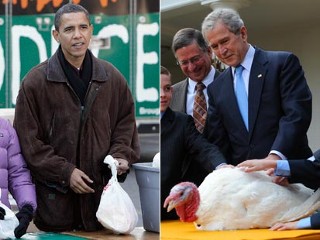
Dressed casually in a leather jacket and black scarf on Wednesday, Obama handed out food to the needy at a Chicago church with his wife, Michelle, and their two daughters, shaking hands and jovially telling people "you can call me Barack."

He followed that with a quick visit to a school next door, where he asked the excited kids, "Who's going to have turkey?" "Who's going to have green beans?" "Who's going to have sweet potato pie?"

Obama has shown a knack for symbolism, in this case following the Thanksgiving tradition of helping the poor, said David Greenberg, a Rutgers University historian. "Here he's showing a different side of himself, the president as national conscience or moral authority," he said.

In an interview broadcast on ABC, the Obamas told Barbara Walters they were having 60 people, at least, to their Chicago home for the holiday.

Michelle Obama said she's not cooking — explaining that she gets "an out" because her husband ran for president.

For Bush, his final Thanksgiving in office is proving a time for nostalgia. He always reflects a bit at Thanksgiving, but he went further this year.

He gave thanks to troops and volunteers, to teachers and pastors, to all the American people. Then he gave thanks for his wife and twin daughters — "two Thanksgiving miracles who we were blessed with 27 years ago" — and that his mother, former first lady Barbara Bush, was doing well after being hospitalized.

"Most of all," he said, "I thank the American people for the tremendous privilege of serving as the president."

In 2003, months after the Iraq war began, Bush surprised soldiers serving in Baghdad by showing up unannounced in their mess hall for the holiday meal.

The more private celebration this year is fitting his lame-duck status, Greenberg said, calling Bush's retreat from the spotlight "kind of like a mutual agreement between him and the American public."

"In a way it would be unseemly if he did anything too flamboyant or too showy," he said.

———

Associated Press writers Sara Kugler in Chicago and Ben Feller in Washington contributed to this report.

[Read More...]

By Matt Frei

BBC News, Washington

You could be forgiven for thinking that Chicago is the new Washington, that the president-elect is already running the country from there and that the West Wing has just become the Mid-West wing.

Even though he assured us again on Tuesday - if assured is the right word? - that he will only take over the reins of power after Inauguration Day on 20 January, Barack Obama talks, decides and reasons as if those reins are already firmly in his hands.

He refers to his weekly radio address like a real president does.

Everything from his body language to his use of the present tense indicates that he already thinks of himself as the commander-in-chief, preparing everything for day one of America's 44th presidency.

The drastic times demand it, he tells us. But then so does his pragmatic and poignant nature, one might add. Compare his behaviour to the unbearable lightness of George W Bush.

Intellect

Mr Obama is not just announcing his cabinet much earlier than most other presidents-elect in transition. He is also telling us in greater detail what his policies will be.

Earlier this week he announced a plan to get 2.5 million Americans back to work. Then he vowed to have his new director of the congressional budget office go through the existing budgets with a scalpel or an axe, depending on what is needed, to cut out any waste.

Previous presidents-in-waiting have also made such claims. But such is Mr Obama's steely-eyed determination and unsmiling sense of purpose that you actually believe him.

As Mr Obama said, talking about his erstwhile colleagues on Capitol Hill: "Friendship doesn't come into this. That's part of the old way of doing things."

You could hear someone, somewhere, gulping.

I also heard him say something that I have not heard for a very long time. As he introduced the latest members of his cabinet, Mr Obama said that they were individuals who had shown "great intellect" as well as courage and commitment.

Intellect?

Sarah Palin and John McCain built their campaign on the tradition nurtured under George W Bush of ridiculing intellect and articulacy as subversive values that rub up against the wholesome grain of middle America.

Mental agility was deemed less important than honesty, sacrifice and leadership. Perhaps.

But why not demand all four of your president and those who serve him? It turned out that a country in peril yearned for leaders with brains.

Because, and here is the funny thing, stupidity and incompetence tend to go hand in hand. So, darngonnit, why not forgive some high falootin' Harvard guy his best-selling memoirs and correct use of English, if he can get us out this mess? Sounds like a bargain to me.

Clinton legacy

When George Bush introduced members of his team, the highest accolade was that they were great Americans and true patriots. It always struck me as odd that patriotism could bestow competence.

President Clinton makes his final address from the Oval office on 18 January, 2001
Could the Obama team realise the failed promise of the Clinton years?

Was not allegiance to the flag one quality that could be taken for granted from anyone who had forgone a huge salary in private industry to earn a paltry one in public service?

Barack Obama, one imagines, assumes that the people who are taking on a raft of potentially soul-destroying jobs in tough times are doing so because they care about their country.

So what about the team? Yes, there are an awful lot of faces from the Clinton past.

Larry Summers, the new economic chief strategist used to be President Clinton's secretary of the treasury. Tim Geithner, the new secretary, worked under him. Peter Orszag, the new director of the congressional budget office is only 39 years old but has also worked for the Clintons.

Bill Richardson, expected to be secretary of commerce, is an old Clinton grandee. Susan Rice, tipped to be the new American ambassador at the UN, worked for Mr Clinton.

The list goes on and there is of course Hillary herself, although you could describe her as the only official from the Clinton era who never actually worked for the president.

Squandered potential

At some stage it would be refreshing to see some new faces from Silicon Valley or the Sun Belt brought into the clutches of government.

So here is my take on the matter. Thanks to the multiple distractions of Bill Clinton and his administration, some of America's brightest people were too busy ducking subpoenas or grappling with indecision at the top to perform their best work.

The Obama administration is a chance for them to prove their critics wrong and to live up to past expectations.

As Hillary Clinton used to say: "Let's undo the damage of eight years of George Bush!"

But how about also realising some of the squandered potential of eight years of Clinton? The state of the nation demands it. The state of the nation may render it impossible.

But as the man who still swivels his chair in the Oval Office once put it under different circumstances: "Bring it on!"

Matt Frei is the presenter of BBC World News Americawhich airs every weekday on BBC News, BBC World News and BBC America (for viewers outside the UK only).


[Read More...]